
 Skip to content
 An anti-static roller is a specialized type of roller used in industrial and manufacturing environments to eliminate or reduce static electricity from surfaces, materials, or processes. It is typically constructed from conductive or semi-conductive materials and is designed to discharge static build-up safely, preventing static-related issues such as dust attraction, sparks, or electronic damage.
Anti-static roller is widely used in industries where static charge build-up can cause problems. Common applications include:
Electronics manufacturing: to prevent electrostatic discharge (ESD) damage to sensitive components.
Printing and packaging: to avoid static-related print errors, ink splattering, or material sticking.
Film and foil processing: to ensure smooth material handling and reduce contamination.
Textile production: to avoid fabric clinging and uneven winding.
Cleanroom environments: to maintain particle-free surfaces by minimizing dust attraction due to static.
PCB production: to protect circuits from ESD during transport and processing.
Anti-static roller is typically made from a combination of the following materials:
Conductive rubber (e.g., NBR with carbon black or polyurethane blends)
Metal cores (usually aluminum or stainless steel)
Carbon fibers or conductive filaments
Conductive silicone
These materials are selected based on the application environment, durability requirements, and conductivity performance.
The main benefits include:
Static elimination: Protects equipment and materials from static charge accumulation.
Improved product quality: Reduces defects caused by static-related dust attraction and material sticking.
Enhanced process safety: Prevents sparks in explosive environments.
Minimized maintenance: Reduces machine downtime due to static-related jams or failures.
Increased production efficiency: Ensures smoother material movement and fewer interruptions.
When selecting an anti-static roller, consider the following:
Material to be processed: Determine the type and thickness of the material (e.g., paper, film, PCB, textile).
Speed of operation: High-speed operations may require more efficient static discharge properties.
Operating environment: Consider temperature, humidity, and chemical exposure.
Required surface resistance: Choose based on whether you need conductive, static dissipative, or insulative properties.
Dimensions: Roller diameter, length, and shaft specifications must match your equipment.
Mounting style: Determine whether fixed, rotating, or spring-loaded mounting is needed.
Surface resistance is a measure of how easily electricity flows across the surface of a material. It is expressed in ohms (Ω). In the context of anti-static rollers:
Conductive: 10³ to 10⁵ Ω – allows electrons to flow freely.
Static dissipative: 10⁶ to 10⁹ Ω – slows the flow of electricity to prevent sudden discharge.
Insulative: Above 10¹² Ω – inhibits the flow of electricity and is generally not used for static control.
Anti-static rollers typically fall into the conductive or dissipative range depending on the intended application.
Proper maintenance is essential for performance and longevity:
Regular cleaning: Use anti-static wipes or mild cleaners to remove dust and contaminants.
Avoid solvents: Harsh chemicals can degrade the roller surface or reduce its conductivity.
Inspect regularly: Check for wear, cracks, or loss of conductivity.
Proper storage: Store in a clean, dry environment away from heat and chemicals.
Anti-static roller themselves are safe to use. However, always ensure proper grounding and electrical continuity, especially in explosive or ESD-sensitive environments. Poor grounding may cause the roller to become ineffective or even hazardous.

We’re professional manufacturer of PCB equipment and consumable. We can give you the best advice for your requirements.
© All Rights Reserved.
WhatsApp us
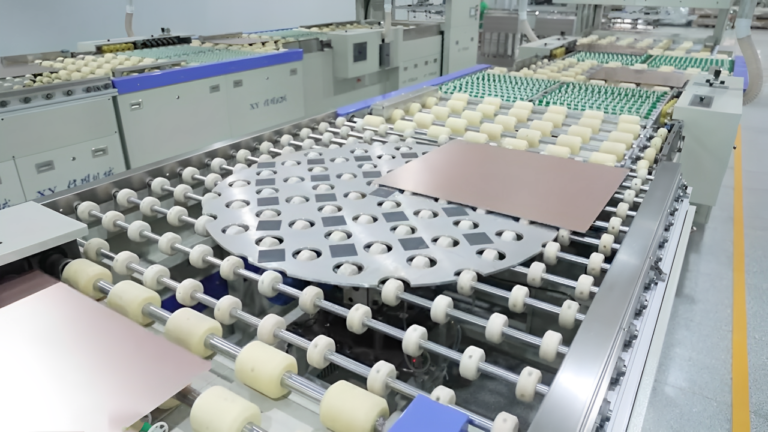
Eternal Tech is committed to becoming an expert in PCB conveying systems.
 Optimized by Seraphinite Accelerator
